A Sector Score Cannot See the Room You Work In
Sector exposure tells you where to look; the worksite tells you what can actually be changed. Test the physical and social constraints around the task.
Sector-exposure supplies the broad industry map; work-environments supplies the physical, hazard, and social conditions that determine whether a particular task can move inside it.
Hard conditions can slow or reshape deployment without securing a role: a firm can still redesign work, move it elsewhere, monitor it more closely, or reduce the surrounding staff.
The trade article is open on a phone beside the broken machine.
It says your whole industry is automatable.
You are standing in rain at a site gate. Or on a ward beside a patient. Or in a plant beside equipment that has stopped for a reason the dashboard did not name.
The headline cannot see any of that.
It can still be useful.
Use it to choose where to look.
Do not use it to decide what your work is worth.
Sector exposure is a map of production environments.
It can show that manufacturing has repeatable cells, that warehouses have controlled lanes, that utilities have fixed networks and telemetry, and that agricultural, mining, and construction work carries changing terrain, materials, and conditions.
It cannot see your room.
That difference changes the automation case.
Industrial robot installations reached 542,000 worldwide in 2024, after exceeding 500,000 for four consecutive years.
That says the capital is real.
It does not say what happened on your shift, in your plant, or at the access point where your job becomes difficult.
The same mistake travels through more polished numbers.
Professional transportation-and-logistics service robots accounted for 102,900 global sales in 2024, up 14%.
The reported class is mainly indoor mobile robots moving goods away from public traffic.
Do not stretch that result across a dock, a driveway, a public road, a customer porch, a damaged pallet, or a warehouse aisle full of people.
The operating domain is the claim.
A digital task can be copied, logged, reviewed, and sent to a model without moving a body or clearing a safety zone.
That lowers the cost of deployment.
It does not mean every screen-based role disappears.
It does mean a physical worksite needs a different inspection.
Start there.
The Flattened Label
Six physical-economy sectors appear together because they contain visible automation routes: agriculture, mining, manufacturing, construction, logistics, and utilities.
They are not six points on a single danger scale.
Agriculture can return equipment to mapped rows and fixed parlours.
It also has weather, soil, plant condition, animal behaviour, pests, terrain, and repairs far from a workshop.
Mining can move haulage and drilling away from a hazardous zone.
It also has changing rock, degraded access, ventilation, ground support, and emergency response.
Manufacturing can design a cell around a fixture, a known part orientation, and a cycle time.
A short-run fabricator can spend more time on programming, fixture changes, and part variation than on the motion a robot performs.
Construction can move some assembly into prefabrication.
The site still has sequence, subcontractors, existing conditions, weather, access, handoffs, and work behind a wall that does not match the drawing.
Logistics can standardize a tote and a lane.
It also has damaged loads, unlabelled goods, dock congestion, customer promises, and public traffic.
Utilities can automate meters, relays, alarms, and routine switching across fixed assets.
A control error still meets storm damage, hospital load, crew location, a partially observed network, and a public-service duty.
The map names a family of work.
Your site determines whether the machine gets a clean problem.
Look at scale before you accept a sector story as your employer’s story.
The 2022 Census of Agriculture recorded 1.9 million U.S. farms averaging 463 acres.
The 6% of farms with at least $1 million in sales accounted for more than three-quarters of products sold.
The 74% of farms selling $50,000 or less accounted for 2%.
Those are not interchangeable operating environments.
A system designed around large, uniform acreage can have little bearing on a small mixed operation growing the same commodity.
Do not call that a contradiction.
Call it the worksite.
The Room
Take out a sheet of paper.
Write five tasks you do often.
Use verbs, not titles.
“Diagnose the fault at the panel.”
“Move the patient from bed to chair.”
“Receive the load at the dock.”
“Fit the component into the renovation.”
“Restore service after a feeder fault.”
Then write the conditions around each task.
Do not write hands-on. That is not an operating description.
Write the light, weather, noise, dust, traffic, temperature, object condition, route, access point, documentation, other people, and exception that turn the task from a demonstration into a working day.
Occupational databases can tell you which conditions are worth asking about.
They are not a site survey.
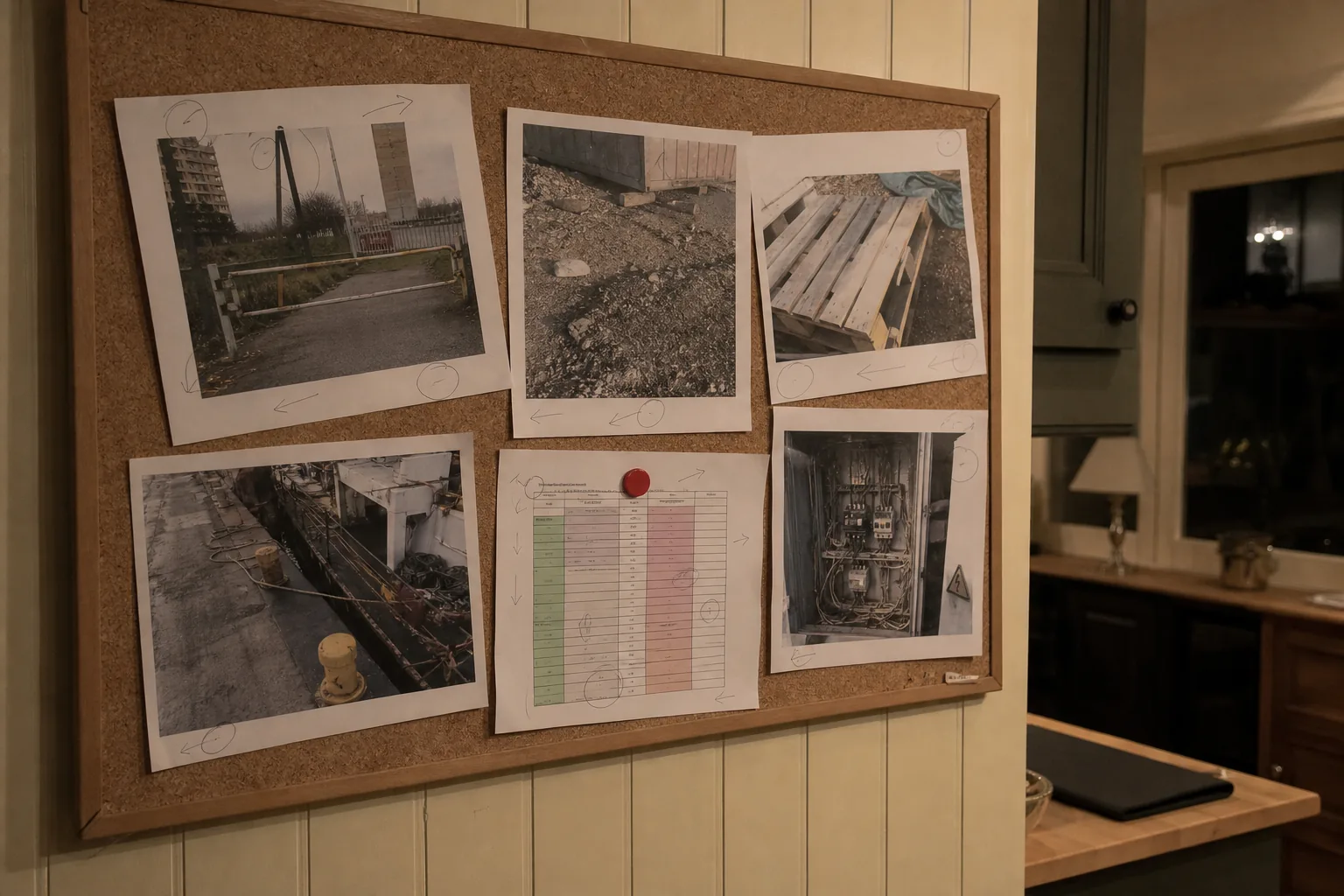
Your site needs observation, photos, process maps, local measurements, and a record of how you actually reach the task.
Use duration too.
Outdoors can mean a brief transfer or every working hour.
In a vehicle can mean a stationary diagnostic job or travel at road speed.
The machine’s requirements change with the duration.
In the 2024 Occupational Requirements Survey, 91.0% of construction and extraction workers had outdoor exposure.
That is not a percentage of automation risk.
It is a condition that changes sensing, traction, power, communication, and the size of the safety zone a machine requires.
The same distinction applies to physical demand.
The survey classified 30.6% of workers at a sedentary strength level, meaning no lifting above 10 pounds and sitting at least two-thirds of the workday.
Those are job requirements.
They are not a verdict on your fitness and not a robot specification.
Turn the category back into geometry.
A rigid box at waist height is not an unstable patient transfer.
An overhead fitting is not a labelled tote.
An object that shifts, leaks, bends, obscures itself, or must be handled near another person changes the task.
That condition has value even when the dashboard does not count it.
The Five-Condition Audit
Score each of your five tasks from 0 to 2 on five conditions.
None of this has been validated.
It is not an exposure estimate and not a redundancy forecast.
Give 0 when the condition is controlled or absent.
Give 1 when it occurs sometimes, has a partial workaround, or affects part of the task.
Give 2 when it is ordinary, consequential, or built into the task.
Variable physical setting. Score weather, terrain, layout changes, lighting, dust, noise, moving people, object pose, traffic, or incomplete information.
A guarded cell with fixtured inputs belongs near 0.
A renovation, mine face, bedside encounter, public road, or changing farm field can belong near 2.
Consequence of error. Score the harm and the recoverability.
A bad part may be rejected before shipment. A construction error can be embedded. A mistaken switching command can require a sequenced restoration.
Record the fail-safe state, escalation route, stop authority, and recovery work.
Unpredictable human contact. Score whether customers, patients, subcontractors, road users, co-workers, or bystanders can enter the task, change its priority, explain an unrecorded problem, reject a result, or be harmed by delay.
Conversation is not the whole category.
Consent, distress, duty, and accountability matter.
Access or safety constraint. Score confined access, height, traffic separation, infection control, heavy equipment, stored energy, hazardous material, public exposure, and the control needed before work begins.
NIOSH’s five control categories are elimination, substitution, engineering control, administrative control, and personal protective equipment.
Keep them distinct.
A warning label is not a robot. And a robot that moves you to a control room is an engineering control, not proof that your role vanished.
Need for on-site manipulation. Score whether the work requires a body and tools to grasp, lift, fit, secure, inspect, clean, adjust, repair, or recover an object in its actual position.
Count the preparation and the recovery, not only the motion in the sales video.
Total each task.
0–3: Controlled task. The environment may be capable of standardization. Ask about inputs, changeover, guarding, integration, quality checks, and who handles faults.
4–6: Mixed task. A machine may take a bounded portion while a person handles setup, exceptions, verification, or the handoff. Do not call the task automated because a portion is visible in a demonstration.
7–10: Worksite case required. A sector headline is not enough. Demand the physical operating domain, the error path, the human contact model, the safety design, the manipulation plan, the fallback, and the person who owns recovery.
Score only conditions you can name.
Do not award a point for anxiety.
Do not remove a point because the industry press calls a technology inevitable.
Error Is Work
The work left around an automated motion is not an apology for keeping you employed.
It is part of the operating cost.
In 2024, private construction recorded 1,034 fatal work injuries, 389 of them falls, slips, and trips.
Those counts do not compare risk without hours worked.
They do not establish an automation benefit.
They establish why safety and recovery cannot be a footnote in the sector comparison.
Mining is the same lesson in miniature.
Most of its fatal injuries fall in support activities rather than at the face.
Do not let the autonomous haul truck stand in for drilling crews, exploration, assay work, construction, transport, inspection, maintenance, or the contractor at the extraction point.
Hazard changes the labour question twice.
It can create a strong reason to move a person away from danger.
It can also require more validation, better safeguards, a remote operator, maintenance staff, and a reliable route back when the system stops.
The hazardous remote-response operator makes this plain.
NIST response-robot tests vary stairs from 30° to 45° and lighting from more than 300 lux to less than 0.1 lux.
Those are test conditions, not product promises.
They show why the robot can drive is not a worksite case.
Mobility, sensing, dexterity, endurance, radio communication, operator proficiency, and recovery all remain in the mission.
You may be farther from the hazard.
Your work may be different, not gone.
The Social Setting
Do not use human interaction as a charm word.
Describe the interaction.
The bedside registered nurse has daily face-to-face discussion for 96% of O*NET respondents and daily disease or infection exposure for 61%.
A patient lift can change manual handling.
Scheduling can route work.
Documentation support can prepare a note.
Dispensing equipment can enforce a check.
The live encounter still couples bodily assessment, privacy, consent, comfort, infection control, rapid coordination, and escalation.
That is not sentiment.
It is an environment with a particular error consequence.
The heavy truck driver works in a different social environment: 96% of respondents in an enclosed vehicle every day, 76% outdoors in all weather every day.
An automated highway segment does not carry the cargo check, dock handoff, breakdown, enforcement encounter, customer contact, weather adjustment, or roadside recovery with it.
Specify the road type, weather, speed, fallback, and remote support.
Then decide what changed.
The software developer is a useful counterexample.
Sitting almost continually, in a controlled digital environment, with versioned artifacts that make output inspectable.
That does not make requirements complete, tests sufficient, security review unnecessary, or accountability absent.
Do not confuse low physical constraint with no constraint.
Still Has Teeth
Do not turn the audit into false security.
Hard physical conditions do not guarantee your work remains on the payroll.
A firm can redesign your role around a prepared subset of tasks.
It can move document work, dispatch, monitoring, scheduling, or record capture to a remote team.
It can offshore the surrounding process.
It can install monitoring that turns your judgment into a narrower procedure.
It can leave vacancies open, reduce contractor use, put more work onto fewer people, or shrink the role while the difficult task remains.
Sector exposure remains useful because those moves usually begin in the standardized core.
Manufacturing has enough repeatable activity to explain half a million industrial robot installations a year.
Utilities have a connected network large enough to make monitoring and control consequential even where field restoration remains local and difficult.
Read those as comparisons, not verdicts.
Ask what happened to the saved time.
Was it spent on more output, fewer labour hours, higher quality, a shorter queue, safer work, higher profit, or a new category of checking and recovery?
Record hires, overtime, contractor use, redeployments, pay, workload, and the task left after deployment.
Do not let a productivity claim answer a distribution question.
The physical and social conditions you manage every day are not scenery around the economic value of your work.
They are part of the value.
Make them visible before someone prices your task as if it happens in an empty room.
Minimum Viable Action
Before you sleep tonight, take five photographs or make five written observations about your most important task.
Capture the condition a remote demonstration would fail to show.
The changing light.
The blocked access point.
The person who interrupts the process.
The object that will not sit still.
The error that has to be recovered on site.
Write the task beside each one.
That is the beginning of a worksite case.
What you will be able to say afterwards
- A sector statistic is a comparison signal rather than a worksite prediction.
- A worksite audit records setting variability, error consequence, human contact, access or safety constraints, and on-site manipulation.
- A five-condition score from 0 to 2 is a structured prompt rather than a validated forecast.
- A task scoring 7 to 10 needs a worksite-specific adoption case rather than a sector headline.
- Hazard counts, occupational context surveys, and local process observations measure different things and must not be merged.
- A robot can transfer hazardous exposure or automate a bounded motion while leaving setup, recovery, inspection, and accountable decision work in place.
Questions this raises
Does a high automation score for a sector mean that every job in it is exposed?
No. A sector combines settings with different materials, layouts, hazards, task variation, and demand. Manufacturing can contain a guarded, repeatable cell and a short-run changeover problem; logistics can contain indoor mobile robots and public-road delivery. A sector score can identify where automation investment is plausible, but it cannot establish the task mix or staffing outcome at one employer.
What should be checked before treating a sector headline as evidence about one worksite?
The check should identify the task, the physical setting at the moment of action, the usual exceptions, the consequence of error, the people who enter the process, the access and safety controls, the objects that must be handled, and the fallback when the system fails. Those conditions determine whether a demonstrated capability can become a maintained local workflow.
Why are warehouse robots not evidence that all transport work can be automated?
The International Federation of Robotics counted 102,900 professional transportation-and-logistics service robots sold globally in 2024, mainly mobile robots moving goods indoors without public traffic. That operating domain excludes much of freight transport, roadside recovery, customer handoffs, variable packaging, weather, public road users, and access problems. The sales figure describes a bounded product category, not all logistics work.
What does a task score of 7 to 10 mean?
A score of 7 to 10 on the five-condition worksite audit means the task has substantial local constraints from setting variability, error consequence, human contact, access or safety, or on-site manipulation. It does not prove that the task is safe from redesign. It means a sector average is insufficient and any automation claim needs a specific adoption case for that worksite.
Why does a dangerous job not automatically become easy to automate?
Hazard can motivate automation while also raising the validation and recovery requirements. Private construction recorded 1,034 fatal work injuries in 2024, including 389 falls, slips, and trips, but those counts are not an automation score or a safety proof for a machine. A credible system still needs a safe state, escalation route, accountable stop authority, and recovery procedure.
What is the difference between an occupational survey and a site measurement?
An occupational survey describes reported conditions for an occupation, while a site measurement describes conditions at a particular employer or task. O*NET's work-context file contains 297,676 occupation-specific ratings, including respondent counts and confidence fields, but it is not a site survey. Equipment decisions need local observation, process maps, photos, measurements, and exception records in addition to occupational data.
Can a robot reduce danger without eliminating the operator's job?
Yes. A robot, drone, or remote vehicle can move a person away from fire, rubble, hazardous material, moving equipment, or an unstable area while leaving a human responsible for observation, interpretation, recovery, and mission decisions. NIST response-robot tests vary stairs from 30 degrees to 45 degrees and light from more than 300 lux to less than 0.1 lux, illustrating the operating conditions that remain relevant.
Why is an automated factory cell different from a repair call at an unknown site?
A factory cell can be fenced, fixtured, guarded, supplied in a known sequence, and designed around a repeatable work envelope. An unknown repair site can have variable access, object position, lighting, hazards, tools, and fault causes. OSHA reports 0 specific standards for the robotics industry, so safeguarding remains a system-specific hazard-analysis and integration problem rather than a generic label.
What does outdoor work change in an automation case?
Outdoor work changes sensing, traction, power, communication, guarding, cleaning, and recovery requirements. In the 2024 Occupational Requirements Survey, 91.0% of construction and extraction workers had exposure to the outdoors. The figure does not make construction immune to automation; it shows why a claimed system must specify weather, terrain, layout, people, access, and the preparation needed for the task.
Why does a truck-driving demonstration not describe the whole job?
A heavy and tractor-trailer truck driver operates a vehicle of at least 26,001 pounds gross vehicle weight and also checks cargo and vehicle condition. O*NET reports 96% working in an enclosed vehicle every day and 76% working outdoors in all weather every day. Driving automation therefore leaves questions about loading, docks, breakdowns, enforcement, customers, and the fallback outside the automated segment.
Does frequent face-to-face work make a job secure from automation?
No. Frequent contact is a condition to inspect, not a security guarantee. O*NET reports daily face-to-face discussion for 96% of bedside registered nurses and daily disease or infection exposure for 61%. Tools can still change documentation, scheduling, dispensing, or patient handling. The relevant question is which observations, consent, escalation, and accountable decisions remain in the live encounter.
What should be recorded when an automated process fails?
The record should identify the source of failure, the affected people, the severity, the route of exposure, the current control, the fail-safe state, the escalation route, the person with stop authority, and the time and work needed to recover. Hazard prevalence, injury outcomes, and process failures use different denominators. Keeping them separate prevents a weak safety claim from becoming a staffing conclusion.