Autonomy Removes a Route Before It Removes an Occupation
Autonomous systems enter bounded routes, warehouses, and delivery flows first. Build a route map to see whether your work is inside the bounded part or the exception layer.
Autonomous-systems maps bounded warehouse and delivery flows; labor-displacement maps the staffing, hiring, and re-employment consequences when those flows are redesigned.
Exception work can be reduced too, and a transfer into supervision may be unavailable when one operator oversees many systems.
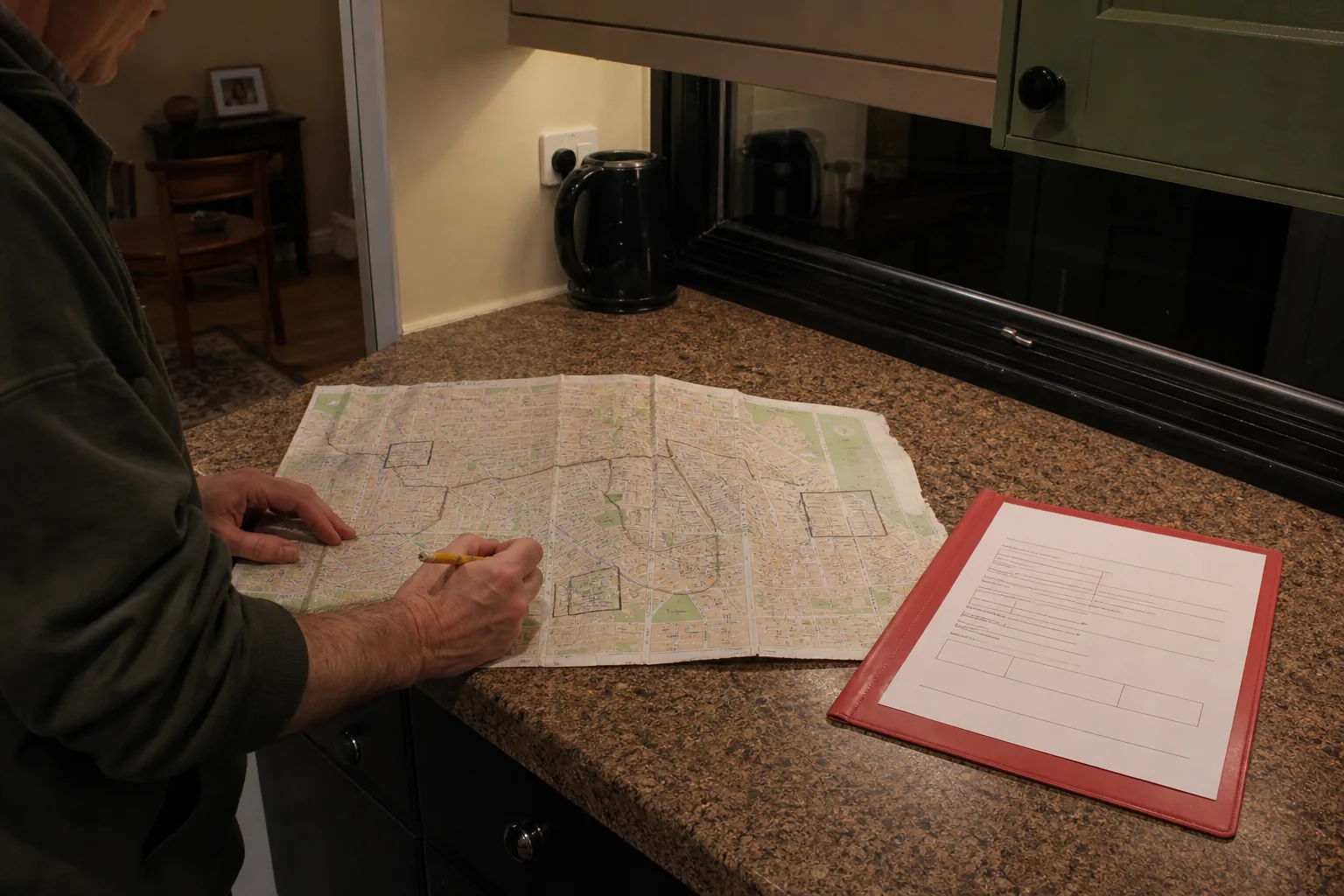
The vehicle takes the cleanest part of the route.
It leaves the depot, stays inside its service area, reaches the address, and opens a compartment.
You get the missed address, the building with no lawful stop, the package that was not in the compartment, and the customer who has been waiting inside a delivery window that no longer means anything.
Maybe this is a road vehicle. Maybe it is a warehouse robot bringing totes to a station while you handle the leaking bottle, the missing scan, and the order that cannot go out.
Do not ask whether the machine can do your occupation.
Draw the route it can do without asking for you.
Smaller Than the Occupation
An autonomous system usually enters a bounded flow before it enters an occupation.
The unit is not courier.
It is a transaction that moves through states.
At 10:03 a.m., one plausible household order contains three stocked items and a two-hour delivery window.
The order system checks payment, fraud rules, inventory promise, address eligibility, temperature requirements, and the service boundary before anything moves.
That first stage can fail before a vehicle exists.
The warehouse then reserves work by location and cut-off.
A fleet manager gives an autonomous mobile robot a transport task: take a shelf, tote, pallet, or cart from location A to station B.
It does not give the machine the occupation warehouse worker.
OSHA describes an industrial robot system as four components: manipulator, controller, teach pendant, and end-effector.
Those components must agree with the fleet manager and the warehouse location data before a transport task is executable.
The clean route is already surrounded by conditions.
Write the states down.
Reserved.
Picked.
Packed.
Loaded.
Released.
Arrived.
Available for collection.
Handed over.
Returned.
Do not collapse those final states into delivered.
A compartment can open at the correct address while an order remains uncollected.
A vehicle can finish its motion task while the commercial delivery fails.
That difference is where a route becomes an occupation.
The Edge
Take out a sheet of paper.
Choose one completed job from today.
Do not choose your job title. Choose one order, tote, pallet, stop, or service call.
Draw a line from the first request to the final payment, settlement, or closeout.
At each handoff, mark one box.
Bounded. The task has defined inputs, defined conditions, a defined output, and a permitted response when something fails.
Supervised. A system moves or proposes; a person releases it, checks it, or owns the outcome.
Exception. The actual condition no longer matches the operating rule.
Customer resolution. The service promise has failed, changed, or needs a human explanation.
Be literal.
The road leg may be bounded by road class, service area, weather policy, vehicle capacity, curb or driveway access, charging margin, and the ability to complete a safe handoff.
The vehicle also needs communications, localisation, sensor health, actuator status, door status, cargo restraint, and a pre-departure route it is allowed to run.
Write the system’s minimal-risk condition beside the route.
It may remain stopped at the depot, pull over where permitted, or return to a known recovery point.
The edge matters more than the centre.
A road closure, emergency request, unlatched compartment, weather suspension, blocked curb, or inaccessible building is not a blemish on the route.
It is the point where the route stops being bounded.
When that happens, the system can create an assistance request with location, scene information, system state, and a proposed safe action.
Do not call that teleoperation unless the service actually assigns a person to drive the vehicle remotely.
NHTSA says every vehicle available for sale in the United States still requires the driver’s full attention.
Its Level 4 description is system driving in limited service areas without a human needed to manoeuvre.
Assistance, driver assistance, remote authorization, recovery, and full autonomy are different claims.
Keep them different on your map.
In the United States, a covered entity must report an automated-driving-system crash when the system was in use within 30 seconds before the crash and the event meets the applicable damage or injury criteria.
That reporting rule is not the recovery plan.
Secure people and cargo, call emergency services where appropriate, preserve data, notify the operator, and prevent the same release condition from reaching another vehicle while the event is reviewed.
The Hard Part
A mobile robot can navigate an operating environment, identify obstacles, and use collision avoidance.
OSHA says it is not designed to carry a seated or standing driver.
That describes a transport function.
It does not resolve an incorrect bin count.
When the physical count and the inventory record disagree, someone may cycle-count, substitute an authorised item, or cancel a line.
The first human decision can be commercial: whether a partial order remains worth sending.
At the pick station, a worker scans the item, confirms quantity, and places it in a tote.
At pack-out, a system weighs the shipment, produces a label, assigns a compartment or staging lane, and changes the order state from picked to ready.
Then the exception layer starts again.
A leaking bottle.
An overfilled tote.
A missing scan.
A prohibited item.
A label that does not match the recipient.
OSHA advises keeping individual items under 10 pounds in item-picking work, or 2 pounds where a pinch grip is used, and totes under 35 pounds.
Those are ergonomic guidance figures, not robot performance specifications.
Use them correctly.
A goods-to-person system can remove your walking while leaving lifting, awkward reaches, damaged packaging, and packing as consequential paid work.
Autonomy makes a bad inventory signal travel faster.
It does not make it true.
BLS projects transportation and material-moving employment to add 579,900 jobs from 2024 to 2034, with stockers and order fillers accounting for about 40% of the gain.
An autonomous warehouse route can therefore change walking, packing, and staffing inside a growing occupational group.
It cannot be translated mechanically into an occupation disappearing.
The Bounded-Stage Share
Now put paid time beside every box.
Use your last ordinary shift, not the day management gave visitors.
Count the minutes you spent in bounded stages.
Count the minutes you spent supervising a bounded stage.
Count the minutes you spent on exceptions and customer resolution.
Then calculate your bounded-stage share: paid time in bounded stages divided by total paid time.
The share is a planning trigger.
It is not a validated measure and not a dismissal forecast.
At 60% or more, begin applying now for exception handling, dispatch, maintenance, inventory control, field recovery, customer resolution, or an adjacent role.
Do it before the pilot expands.
Do not wait for the system to take the final stage.
The rule does not mean 60% of your job is gone.
It means most of your paid time depends on a flow whose ordinary conditions can be redesigned without consulting the title on the payroll.
When the ordinary flow is the majority of your day, the remaining time is not necessarily protected.
It is work the operator has not yet priced out.
Score the supervision honestly.
One operator can oversee many systems.
A transfer from driving or picking into supervision can therefore be unavailable even when supervision remains.
Exception work can shrink too.
Better maps, narrower service areas, packaging changes, customer self-service, improved inventory records, and a redesigned handoff can remove the very circumstances that presently call you.
Do not treat the exception layer as a sanctuary.
Treat it as a place to inspect for accountable work, scarce judgment, repair capability, and a path employers actually hire for.
Cost per Completed Order
Your employer may be buying reliability in narrow conditions.
It may want later cut-off times, predictable travel, a narrower arrival window, more capacity, fewer missed trips, or less recruiting pressure.
It may also want fewer paid labour hours per completed order.
Those are separate claims.
Use cost per completed order, successful delivery, or pallet move.
Do not stop at cost per robot-hour or cost per autonomous mile.
The larger denominator has to include loading, cleaning, charging, customer support, waiting at a curb, remote assistance, field recovery, software licences, maps, maintenance, insurance, facility rent, and downtime.
A vehicle that is cheap while moving but unavailable during the delivery peak forces a conventional fleet to remain, or breaks the service promise.
Redundancy is part of the unit cost until the system can meet the promise.
The transportation and material-moving occupational group had a 2024 median annual wage of $42,740.
That is a scale for labour expenditure, not a robot-price comparison.
It combines driving, picking, supervision, and maintenance, while employer cost also includes overtime, payroll taxes, benefits, recruiting, injury, and turnover.
The same occupational group is projected to see about 1.8 million openings a year through 2034, mostly replacement needs.
That is one reason an employer can value an autonomous system for recruiting, retention, capacity, or resilience without a local headcount reduction being the business case at all.
Rising volume can create work while automation constrains labour demand.
Labour hours released can become capacity, shorter queues, reduced overtime, fewer hires, or payroll removal.
Make your employer name which one.
The Staffing Margin
Headcount is a late measure.
Watch the route’s staffing margin before anyone calls it a layoff.
Record headcount.
Record vacancies.
Record hires and departures.
Record contractors, agency workers, overtime, output, and task time.
Then record the route stages each measure serves.
An employer that does not replace a departing dispatcher, picker, recovery driver, or customer-service worker has changed access to work even when the current team stays intact.
A route can be redesigned by attrition.
The job that vanishes first may be the job nobody is allowed to enter.
Use a cohort cut.
An operation with 80 people, 12 entrants a year, and a six-year average tenure has a different pathway risk from an operation with the same headcount and no entry pipeline.
Ask for the decision rule.
Will safety-critical vacancies be filled within 30 days?
Will a pilot pause backfilling only while it is evaluated?
Will apprentice and entry intake be maintained?
Then ask what notice looks like when the decision arrives.
In BLS data for 2021–23, only 42% of workers whose positions or shifts were abolished received written advance notice.
Among long-tenured displaced workers, 46% did, and reemployment did not differ statistically by whether notice was received.
Notice without a route to paid work is information without a bridge.
Use the route map before the decision becomes irreversible.
In the six months before a closure or attrition plan, identify affected roles, receiving employers, training places, transit, childcare, and income needs.
In the first year, record who actually starts work rather than who enrolled in a service.
OECD’s review of eight international case studies finds that isolated measures rarely work.
Outcomes depend on strategies matched to the workers, the place, and the timing.
The Work Left
Do not accept supervisor as an escape plan without checking the vacancy.
Name the destination role.
Name the employer.
Name the entry requirement.
Name the pay, hours, contract type, commute, and whether the role uses the skill you are being told to learn.
A short unpaid course and a paid placement lasting a year are not two grades of the same product.
One may produce a credential. The other creates work history, references, and exposure to real edge cases.
If a firm needs people after an automated flow, its assessment should test exception diagnosis, audit trails, customer explanation, and escalation.
Prompting a tool is not evidence that you can carry the recovery.
Customers pay for a completed service.
Employers pay for a route until they can buy the result another way.
Study the handoff where reality interrupts the machine.
Then study whether anyone is paying for the person who handles it.
Your occupation title can conceal a route that is already being narrowed underneath it.
The title is the last thing to change.
Which is exactly why it is the wrong thing to watch.
Minimum Viable Action
Before you sleep tonight, draw the actual route of one job you completed today.
Put a box around every exception.
Write paid minutes beside each box.
Calculate your bounded-stage share.
If it is 60% or more, write down one exception, dispatch, maintenance, recovery, or customer-resolution role, and the first employer that hires for it.
What you will be able to say afterwards
- A completed autonomous road leg is not the same thing as a completed commercial delivery.
- A route map separates bounded, supervised, exception, and customer-resolution stages.
- The 60% bounded-stage share is a planning trigger, not a validated prediction of job loss.
- Remote assistance and teleoperation are not the same as full autonomy.
- Cost per completed order or successful delivery is more informative than cost per robot-hour or autonomous mile.
- Hiring, vacancies, contractors, overtime, and task time reveal displacement earlier than headcount alone.
- A no-layoff commitment can protect incumbents while leaving entry routes and transfers unprotected.
Questions this raises
Does a driverless vehicle reaching an address mean the delivery job is gone?
No. Reaching an address completes a motion task, not necessarily a commercial delivery. The final flow still distinguishes arrived, available for collection, handed over, refused, and failed delivery. Authentication, inaccessible buildings, age-restricted goods, stairs, uncollected packages, refunds, and customer contact can require a different service design or human work after the vehicle completes its route.
What does a route map show that a job title does not?
A route map shows the order, handoffs, controls, and exceptions inside one completed transaction. It can separate reservation, picking, packing, loading, vehicle release, road movement, proof of handoff, reconciliation, and recovery. A title such as courier, dispatcher, picker, or driver combines those stages, so it cannot show which paid hours fall inside a bounded operating domain.
What should count as a bounded stage in an autonomous delivery flow?
A bounded stage has defined inputs, operating conditions, state changes, and an allowed response when conditions fail. A vehicle route can be bounded by road class, service area, weather policy, capacity, curb access, charging margin, and handoff rules. A warehouse transport task can be bounded by locations, fleet availability, battery state, route availability, and compatible location data.
What happens when more than 60% of paid time is inside bounded stages?
A 60% share is a planning trigger, not a forecast of dismissal. At or above that share, a worker begins applying for exception handling, dispatch, maintenance, inventory control, recovery, customer-resolution, or adjacent work before a pilot expands. The calculation identifies dependence on routinized stages; it does not establish that an employer will cut a particular job or date a reduction.
Is remote assistance the same thing as a person driving the vehicle from an office?
No. An automated driving system can create an assistance request when a road closure or other condition falls outside its operating rules. A human can authorize a reroute or initiate recovery without operating the vehicle as a remote driver. NHTSA describes Level 4 as system driving in limited service areas without a human needed to manoeuvre; the actual service design determines the human role.
Why are warehouse robots not just replacements for warehouse workers?
An autonomous mobile robot can move a shelf, tote, pallet, or cart between locations, but picking, scanning, packing, mismatch resolution, loading, and inventory correction remain separate stages. OSHA advises keeping individual items under 10 pounds, or 2 pounds with a pinch grip, and totes under 35 pounds in item-picking work. Goods-to-person design can reduce walking while leaving lifting, packing, and exception work consequential.
What is the right cost measure for an autonomous route?
Cost per completed order, successful delivery, or pallet move is closer to the operating question than cost per robot-hour or autonomous mile. The broader measure includes loading, cleaning, charging, customer support, curb waiting, recovery, network service, maintenance, insurance, facility cost, and downtime. A low-cost vehicle that is unavailable during a delivery peak still requires conventional capacity or causes service failure.
Can autonomy reduce hiring without causing a visible layoff?
Yes. An employer can leave vacancies unfilled, cancel requisitions, stop replacing departures, reduce agency work, or change overtime before headcount falls. A workforce baseline separates headcount, vacancies, hires, departures, contractors, overtime, output, and task time. That makes a reduction in labour demand visible instead of presenting a smaller future workforce as ordinary turnover.
Does a no-layoff promise protect the route into the occupation?
Not necessarily. A no-layoff pledge lasting 24 months can protect people already on payroll while saying nothing about graduate, apprentice, or entry hiring. A protected incumbent and a protected pathway are different commitments. Minimum entry hires, paid training places, redeployment eligibility, wage protection during learning, and vacancy rules make the pathway observable rather than assumed.
What should a worker record after an autonomous pilot starts?
A worker records the route population, stages covered, hours in each stage, human overrides, recovery events, failed handoffs, customer contacts, vacancies, cancelled requisitions, contractor use, overtime, output, and task time. The record distinguishes a bounded pilot from routine service and separates reduced walking or driving time from payroll savings, reduced hiring, reassignment, or a larger operating volume.
Does national transportation employment growth prove that autonomous delivery is harmless?
No. BLS projects transportation and material-moving employment to grow 4.1% from 2024 to 2034, with about 1.8 million openings a year including replacement needs. Those aggregate figures neither validate nor refute a local autonomous-route investment. Demand growth, retirements, e-commerce volume, occupation mix, and a particular employer's staffing policy can move differently from the national total.
Why should re-employment be measured after a route is redesigned?
A later job does not by itself show recovery. For U.S. long-tenured workers displaced in 2021–23, 65.7% were reemployed in January 2024, while 16.1% were unemployed and 18.2% were out of the labour force. Measures need start date, occupation, hours, wage, benefits, contract type, commute, credential use, and later retention rather than placement alone.